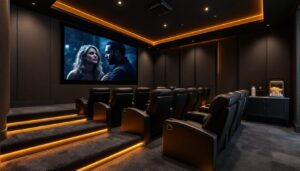

Hiding bulky speakers while achieving theater-quality sound isn’t magic, it’s engineering. In-wall home theater speakers mount flush with drywall, delivering immersive audio without eating up floor space or dominating the room’s design. They’re ideal for dedicated home theaters, media rooms, or living spaces where aesthetics matter as much as performance. This guide covers what these speakers are, how to choose the right models, and how to install them yourself without calling in a pro. Whether you’re building a 5.1 surround system or upgrading a single room, understanding the mechanics and installation process will save time, money, and frustration.
Key Takeaways
- In-wall home theater speakers mount flush with drywall between studs, delivering immersive audio while saving floor space and maintaining clean room aesthetics.
- Select enclosed speaker models with backboxes for rooms where sound leakage is a concern, and choose 6.5-inch woofers for surrounds or 8-inch woofers for front channels based on your setup.
- Proper placement requires front speakers at ear height (36–42 inches), surround speakers 2–3 feet above ear level on side walls, and Atmos height channels in the ceiling.
- Use only CL2 or CL3 rated in-wall speaker wire per the National Electrical Code, verify stud locations with a stud finder, and always test for obstructions before cutting drywall.
- Verify polarity before closing walls—reversed connections cause phase cancellation and weak bass—and secure speakers with gradual, cross-pattern screw tightening to avoid warping the frame.
What Are In-Wall Home Theater Speakers and How Do They Work?
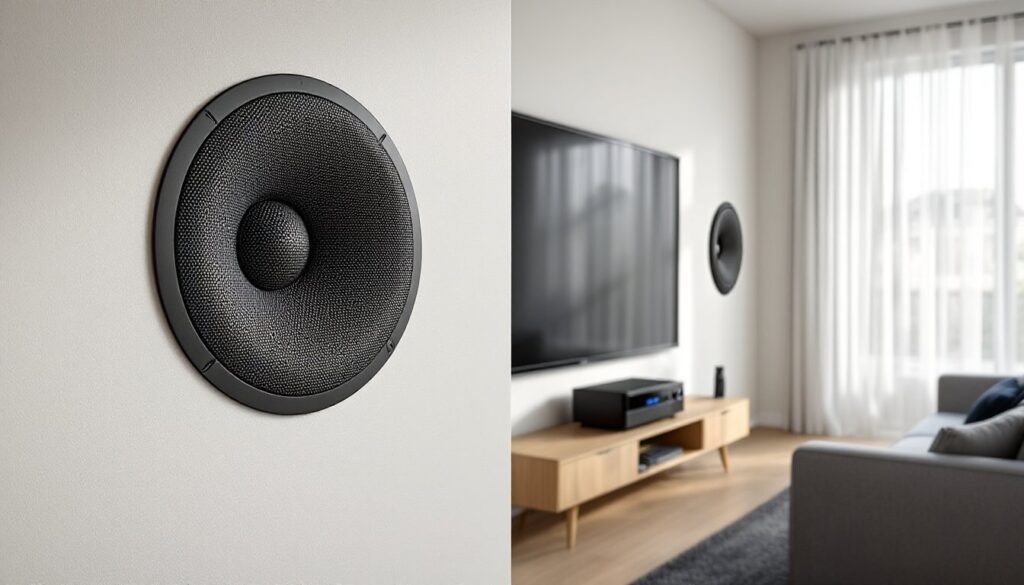
In-wall speakers are designed to mount inside a wall cavity, sitting between studs. Unlike bookshelf or floor-standing speakers, they use the wall itself as part of the enclosure. Most models feature a rear enclosure (sometimes called a backbox) that isolates the speaker from the wall cavity, preventing sound from leaking into adjacent rooms and improving bass response.
The speaker driver, the cone that moves air, faces into the room through a grille that sits flush with the drywall. Higher-end models include pivoting tweeters so you can aim high frequencies toward the listening area. This matters because treble is directional: a fixed tweeter pointed at the ceiling won’t deliver the same clarity as one angled toward your couch.
Installation requires cutting a hole in the drywall and securing the speaker with mounting clamps (dog-ear brackets) that grip the back of the drywall as you tighten screws. Speaker wire runs through the wall cavity from your AV receiver to each speaker location. The entire assembly disappears behind a paintable grille, leaving only a subtle rectangular outline.
Sound quality depends on driver size, enclosure design, and power handling. A typical 6.5-inch in-wall speaker works well for surrounds in a 5.1 or 7.1 setup, while 8-inch models handle front channels where you need more low-end presence. Dedicated in-wall subwoofers exist but are less common, most builders pair in-wall mains and surrounds with a traditional powered subwoofer.
Benefits of Installing In-Wall Speakers for Your Home Theater
The biggest advantage is space savings. In-wall speakers free up floor and shelf space, which matters in smaller rooms or open-concept layouts where traditional towers would obstruct sightlines. They’re also safer in homes with kids or pets, no toppling towers or tangled cables.
Aesthetics run a close second. Paintable grilles blend into walls, and many models include magnetic grilles that snap on without visible screws. This clean look appeals to anyone who wants cinema sound without the visual clutter of a traditional speaker array.
In-wall speakers simplify cable management. All wiring runs inside walls, so there’s no need for surface-mounted conduit or cable raceways. This is particularly useful for surround channels, where running wire across a room to rear speakers can be a headache with traditional setups.
From a performance standpoint, proper in-wall installation can reduce reflections off nearby surfaces, since the speaker sits flush rather than projecting into the room. This can tighten imaging and reduce muddiness, especially in acoustically untreated rooms.
Finally, in-wall speakers can add value to a home. A built-in theater system is a selling point, especially in newer construction or renovated spaces. They’re seen as a permanent upgrade rather than portable gear the seller might take when they move.
Choosing the Right In-Wall Speakers for Your Space
Start by deciding whether you need enclosed or open-back speakers. Enclosed models have a sealed backbox that contains sound and improves bass, these are mandatory if the wall cavity opens into another room. Open-back speakers rely on the wall cavity itself as an enclosure, which can work in exterior walls or dedicated theater rooms where sound leakage isn’t an issue. Enclosed designs are almost always the safer choice.
Driver size matters. 6.5-inch woofers handle mid-bass and dialogue well, making them solid picks for surround channels. 8-inch woofers deliver more low-frequency output and work better for front left/right speakers, especially if you’re running a smaller subwoofer. If your AV receiver supports bi-amping or Dolby Atmos height channels, consider dedicated height speakers with angled drivers that fire downward from the ceiling.
Sensitivity and impedance affect how much power you need. Most in-wall speakers run 8 ohms and show sensitivity ratings between 87 dB and 92 dB. Higher sensitivity means the speaker plays louder with less amplifier power, which matters if you’re using a budget receiver. Match impedance to your receiver’s specs, most handle 8 ohms easily, but some struggle with 4-ohm loads.
Check frequency response specs. A range of 50 Hz to 20 kHz is typical: anything dipping below 50 Hz in a passive in-wall is marketing fluff unless it’s a very large woofer with a serious enclosure. Independent reviews from sources tracking top-rated in-wall speakers can help sort real performance from spec-sheet hype.
Speaker Placement and Configuration Tips
Front left and right speakers should flank your TV or projection screen at ear height when seated, typically 36 to 42 inches off the floor. Angle them slightly toward the main listening position if the speakers have pivoting tweeters. The center channel sits directly above or below the screen, also at ear level if possible.
Surround speakers in a 5.1 setup go on the side walls, slightly behind the seating area and 2 to 3 feet above ear level. For 7.1 systems, add rear surrounds on the back wall, again above ear level. Atmos height channels mount in the ceiling, ideally a few feet in front of and behind the listening position.
Avoid placing speakers in exterior walls in cold climates unless the cavity is well insulated, temperature swings can affect performance. Also, keep speakers at least 18 inches from room corners to reduce bass buildup and boomy resonance. Stud spacing (typically 16 inches on center) limits placement flexibility, so measure stud locations before finalizing your layout.
Step-by-Step Installation Guide for DIY Enthusiasts
Tools and materials you’ll need:
- Stud finder (electronic models work best)
- Drywall saw or oscillating multi-tool
- Drill with bits
- Wire strippers and cutters
- Level
- Pencil
- In-wall-rated speaker wire (14-gauge or 12-gauge)
- Old-work electrical boxes (if required by local code for speaker terminations)
- Safety glasses and dust mask
Step 1: Plan and mark speaker locations. Use a stud finder to locate studs, then mark speaker positions on the wall. Ensure each speaker fits between two studs, most in-wall models are designed for 14.5-inch or 16-inch on-center stud spacing. Hold the speaker template (usually included) against the wall and trace the cutout.
Step 2: Cut the drywall. Put on safety glasses and a dust mask. Use a drywall saw or oscillating tool to cut along your traced line. Start with a small pilot hole to confirm there’s no wiring, plumbing, or ductwork in the cavity. If you hit a stud, reposition the speaker.
Step 3: Run speaker wire. This is the trickiest part. If you’re working in new construction or have attic/crawlspace access, running wire is straightforward, drill through top plates and fish wire down to each speaker hole. For finished walls, you may need to cut small access holes or use a fish tape. In-wall speaker wire must be CL2 or CL3 rated per the National Electrical Code (NEC Article 640), standard lamp cord isn’t legal inside walls.
Run wire from your AV receiver location to each speaker. Label both ends. Leave 2 to 3 feet of extra wire at the speaker hole to make connections easier.
Step 4: Strip and connect wires. Strip about 1/2 inch of insulation from each conductor. Most in-wall speakers use spring-loaded terminals or binding posts. Connect positive to positive (usually marked red or with a stripe on the wire jacket) and negative to negative. Double-check polarity, reversed connections cause phase issues and weak bass.
Step 5: Secure the speaker. Push the speaker into the cutout, keeping wires clear of the mounting clamps. Tighten the mounting screws gradually in a cross pattern (like tightening lug nuts on a tire). The dog-ear clamps will rotate and grip the back of the drywall. Don’t overtighten, you can crack drywall or warp the speaker frame.
Step 6: Attach the grille and test. Snap or screw the grille in place. Power on your AV receiver and run a test tone to each speaker. Listen for crackling (loose connection), no sound (reversed polarity or bad connection), or distortion (damaged driver).
Permit and code notes: Some jurisdictions classify in-wall speaker installation as low-voltage electrical work and require a permit. Others treat it as a cosmetic modification. Check with your local building department. If you’re uncomfortable running wire or cutting into walls, hiring a licensed installer typically costs $100 to $200 per speaker, including labor.
Common Mistakes to Avoid When Installing In-Wall Speakers
Skipping the stud finder. Cutting into a stud ruins the speaker opening and creates extra work. Always verify stud locations before cutting.
Using the wrong wire. Standard speaker wire without CL2/CL3 rating isn’t legal in walls and can be a fire hazard. It’s also a red flag during home inspections. Buy the right stuff upfront.
Ignoring insulation. If the wall cavity is filled with fiberglass or foam insulation, you’ll need to clear a path for the speaker and its backbox. Compressed insulation against the speaker can muffle sound and trap heat if you’re driving the speakers hard.
Forgetting to check for obstructions. Always drill a pilot hole and peek inside before making the full cutout. Hitting a pipe or electrical cable is expensive and dangerous. If you’re unsure, use an inspection camera (cheap models plug into a smartphone).
Placing surrounds too low. Surround speakers at ear level or below don’t create the enveloping effect they’re designed for. Elevation matters, 2 to 3 feet above seated ear level is the sweet spot for most rooms.
Not testing polarity. Reversed polarity on one speaker causes phase cancellation. Bass sounds thin, and imaging feels off. A $10 polarity tester or the pink noise test on your receiver’s setup menu catches this before you close everything up.
Skimping on speaker quality. Budget in-wall speakers often use paper cones and weak magnets. They’ll work, but they won’t match the performance of even entry-level bookshelf speakers. If sound quality matters, spend a bit more. Resources like expert comparisons of highly rated in-wall models can guide better purchasing decisions.
Conclusion
In-wall speakers deliver clean aesthetics and solid performance without sacrificing floor space, making them an excellent choice for modern home theaters. Success comes down to choosing the right models for your room, placing them thoughtfully, and installing them with care. The work isn’t complicated, but it does require measuring twice, cutting once, and respecting building codes. Done right, a DIY in-wall speaker system looks professional and sounds great for years.